Building trust in AI. One hiring decision at a time.
Turning black-box AI rankings into transparent, human-centered hiring decisions.
PROJECT
TalentAI
MY ROLE
Co-founder · Lead UX & Product Designer
TIMELINE
2025 — 2026 · PureGen
TalentAI — Recruiter workspace
THE CONTEXT
Start with the people. Understand the problem.
An AI-native applicant tracking system that helps recruiters evaluate candidates without giving up their judgment. This solution proposal brings match quality, confidence, and explainability into one coherent experience.
THE CHALLENGE
A fast answer is not always a trusted answer.
The system could generate a shortlist in seconds, but adoption remained below 30%. Recruiters could not understand why one candidate ranked above another, hiring managers felt out of control, and compliance teams lacked defensible explanations. Speed alone was not solving the problem.
“Don't just tell me who the top candidates are. Show me why.”
Hiring manager persona · Design research artifact
Understanding three perspectives: speed, confidence, and accountability.THE APPROACH
Designing a partnership, not a black box.
I reframed the experience around human–AI collaboration: make the reasoning visible, separate candidate fit from confidence in the evidence, and give recruiters meaningful control over the final shortlist.
01
Make the reasoning visible
Separate Match Score from Confidence Score so a strong fit is never mistaken for strong evidence. Surface missing information and explain why each candidate is ranked.
02
Keep people in control
Allow recruiters to review, correct, and freeze a candidate’s position before a hiring-manager handoff. Explain the consequences of every consequential action.
03
Design for uncertainty
Route low-confidence candidates into an improvement workflow rather than hiding uncertainty behind a single score. Preserve a traceable decision history.
THE THINKING BEHIND THE INTERFACE
From an AI recommendation to an informed human decision.
A ranked list is not enough when the person making the decision cannot tell whether the evidence is reliable. The central UX task is to make a recommendation understandable, challengeable, and ready for a human handoff.
DESIGNED FOR
Recruiters, hiring managers, and compliance reviewers
A UX reading of the supplied artifacts. The sequence below explains the design logic, not a verified chronology of research. Intended benefits and proposed tests are not measured outcomes.
The user's path
Review candidate fit
Inspect supporting evidence
Resolve uncertainty
Freeze for review
Hand off to a manager
PROCESS & ARTIFACTS
How the problem becomes an interface.
01
Frame the different needs
The persona artifact distinguishes recruiter speed, manager confidence, and compliance accountability. This keeps the brief from treating every stakeholder as a single generic user.
02
Map where trust can break
The workflow and journey maps connect candidate intake, evaluation, missing evidence, and handoff. Their purpose is to expose the decisions and exceptions between screens—not just describe the happy path.
03
Translate uncertainty into controls
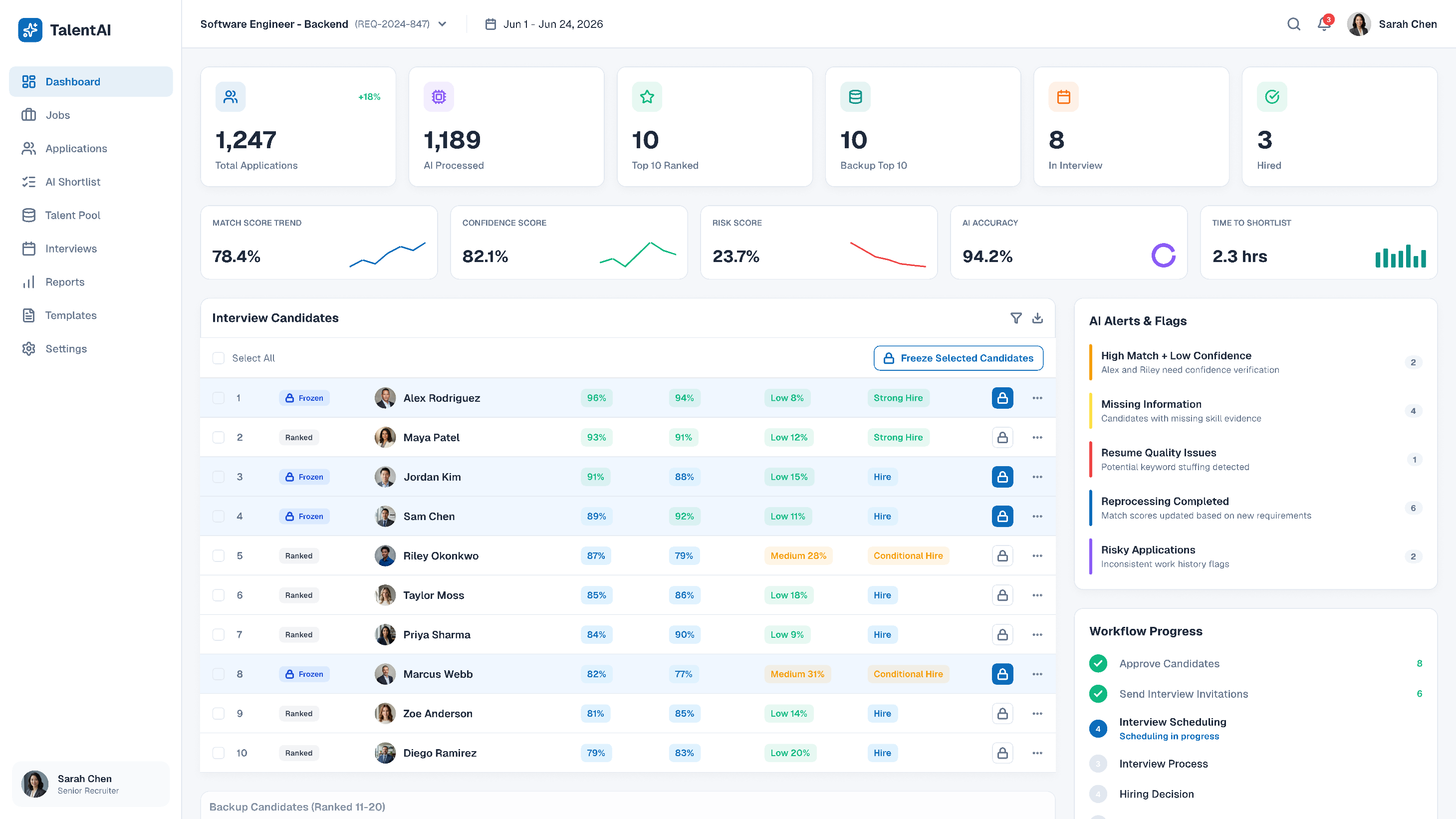
The workspace brings match, confidence, alerts, and shortlist controls together. The freeze dialog then makes the consequence of stopping automatic updates explicit.
04
Test comprehension before efficiency
Next, ask recruiters to explain a ranking, identify weak evidence, and predict what freezing does. These are proposed validation tasks, not completed research findings.
Decision in context: the freeze confirmation makes an automated-ranking change explicit before the recruiter commits.
WHY IT IS DESIGNED THIS WAY
Every choice has a reason. And a trade-off.
Separate fit from confidence
A candidate can be a strong match while the available evidence is incomplete. Separate signals help people avoid equating a high ranking with certainty.
THE TRADE-OFF
Two scores require explanation. Labels and evidence must make the distinction understandable without asking people to learn the model.
Explain before confirming
The freeze confirmation places the consequence beside the action: future recalculation will not change the frozen candidate. This supports informed commitment.
THE TRADE-OFF
Confirmation adds friction. Reserve it for consequential changes rather than every routine action.
Keep exceptions in the workflow
Missing information belongs in an improvement path, not hidden behind a confident-looking score. This gives the recruiter a next step.
THE TRADE-OFF
Flags can become noise. Prioritize actionable uncertainty and avoid treating every missing field as equally urgent.
FROM STRATEGY TO SCREENS
One system. A more transparent journey.
Connect the evaluation engine to the decisions people actually need to make.
The proposed recruitment workflow: AI-assisted evaluation, human-led decisions.Journey mapping exposes trust gaps across the entire hiring experience. Metrics shown in this artifact are illustrative targets.THE RECRUITER WORKSPACE
Evidence at a glance. Control within reach.
The dashboard separates match, confidence, and risk. Ranked candidates sit alongside actionable flags and workflow progress, making it easier to review evidence before approving a shortlist.
The full recruiter dashboard concept. Candidate data and performance figures are illustrative.A MOMENT THAT MATTERS
Freeze the shortlist. Not the human judgment.
Once a recruiter is ready for a manager review, a candidate can be frozen in the shortlist. A confirmation explains that future re-ranking and score updates will no longer affect that candidate, making the consequence explicit before the action.
An explicit confirmation before a consequential action.Contextual guidance explains what frozen means.
Explore more process artifacts +Exploring decision routing, missing-information requests, and the talent pool.A second journey-map exploration. Performance indicators shown are proposed targets, not validated results.WHAT SUCCESS WOULD LOOK LIKE
Measure trust, not just speed.
<30%Shortlist adoption at the starting point
>70%Proposed shortlist adoption target
Human-ledFinal decisions, with traceable reasoning
These are the baseline and success criteria documented in the proposal, not claimed post-launch results.
AI adoption depends on whether people feel empowered, not replaced. This proposal makes explainability, correction, and human judgment part of the core workflow—not an afterthought. The next step is to validate shortlist comprehension and confidence through usability testing, trust-calibration surveys, and audit simulations.